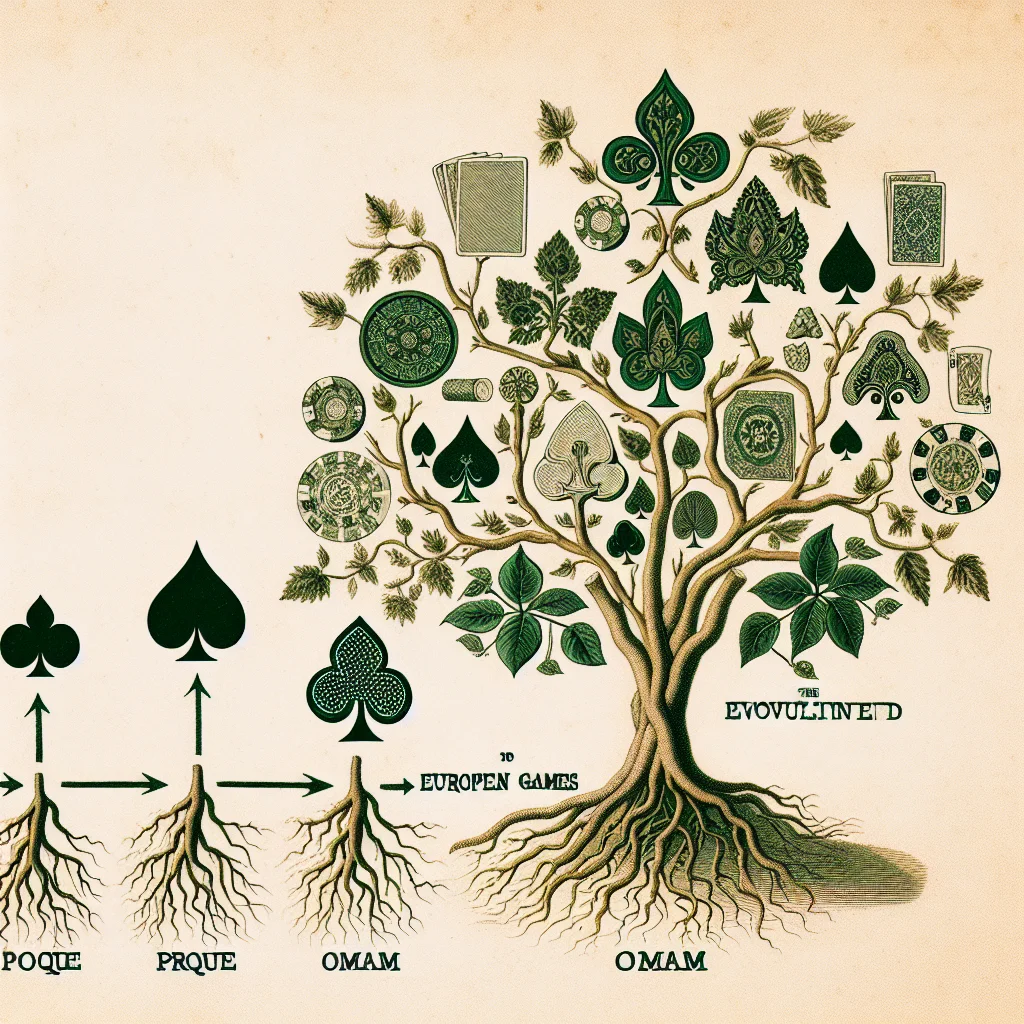
Ancient Roots: The Persian and European Ancestors
The story of poker’s variants begins not with a single game, but a confluence of several. The most direct lineage is traced to the 16th-century Persian game ‘As Nas’. Played with a 25-card deck and five suits, it featured hand rankings that are unmistakably familiar: pairs, two pairs, three of a kind, and the full house (called a ‘full’). This game traveled to Europe, likely through Italian traders or French sailors. In France, it transformed into ‘Poque’, utilizing a 32-card deck and introducing the concept of bluffing (“bluffer”). Simultaneously, in Germany, the game ‘Pochen’ (to knock) was popular, a vying game where players would announce their hands. Across the English Channel, ‘Brag’ was a national obsession, a three-card game that heavily emphasized bluffing and featured a primitive ranking system. These games shared a core DNA: betting rounds, hand rankings, and the psychological element of deception. When French colonists brought Poque to New Orleans in the early 1800s, it met the English 52-card deck and the frontier spirit, creating a primordial soup from which the first true poker variants would crystallize, blending the structure of Poque with the card pool of Brag.
The 19th Century: Draw and Stud Forge the Foundation
As poker solidified its identity in America, two dominant families of variants emerged, each teaching different core skills. ‘Draw Poker’ became the first widely popular form. In its classic Five-Card Draw format, each player received five private cards, followed by a betting round, then an opportunity to discard and draw new cards, followed by a final bet and showdown. This variant placed a premium on pure bluffing and hand-reading, as no community information was available. It was the game of choice in saloons and on riverboats, perfect for quick, tense confrontations. Meanwhile, ‘Stud Poker’ began to develop. Initially as Five-Card Stud (one card down, four up), it offered more information. Players could see part of each other’s hands, shifting the skill towards memory, deduction, and calculating live odds based on visible cards. Seven-Card Stud later became the dominant stud variant, adding complexity with more betting rounds and a mix of hidden and exposed cards. For nearly a century, Draw and Stud were poker. They established the fundamental mechanics of betting structures (limit, pot-limit, no-limit) and created the strategic dichotomies between concealed information and revealed information that would define all future variants.
The Community Card Revolution: Hold’em and Omaha Emerge
The most significant evolutionary leap came with the invention of community card games. While their exact origins are murky, ‘Texas Hold’em’ is believed to have been born in Robstown, Texas, in the early 1900s. Its revolutionary mechanic was simple yet profound: each player receives two private cards, but must make their best hand using five community cards dealt face-up in the center of the table. This created a shared informational landscape of immense strategic depth. Players had to calculate not just their own hand potential, but the potential hands of all opponents based on the communal board. It allowed for more players per table and created dramatic, multi-way pots. Hold’em spread slowly through Texas before being introduced to Las Vegas in 1967. Its cousin, ‘Omaha Hold’em’ (now just Omaha), likely developed as a twist, where players receive four private cards but must use exactly two of them with three community cards. Omaha, particularly in its Pot-Limit format, offered even more hand combinations and complex equity calculations. These community card games shifted poker’s strategic axis from pure hand-reading to a sophisticated analysis of ranges, board textures, and shared possibilities, setting the stage for the game’s mathematical modern era.
Niche and Regional Variants: The Living Fossils of Poker
While Hold’em and Omaha dominate globally, a rich ecosystem of niche and regional variants persists, acting as living fossils of poker’s evolutionary past. ‘Razz’, a Seven-Card Stud variant where the lowest hand wins, remains a staple in mixed-game events, preserving the stud format in a inverted form. ‘2-7 Triple Draw’ and ‘Badugi’ are lowball draw games popular among high-stakes specialists, keeping the draw poker tradition alive with intricate strategies around drawing to specific low hand shapes. In home games across the world, wild and dealer’s choice variants flourish. Games like ‘Baseball’ (with wild 3s and 9s), ‘Follow the Queen’, or ‘Anaconda’ (a pass-and-draw game) showcase poker’s playful, social side. In Europe, ‘Irish Poker’ (a mix of Hold’em and Omaha phases) has followers. These games are more than curiosities; they serve as training grounds for specific skills. Razz teaches board reading and ace-management in a lowball context. Triple Draw is a masterclass in hand dissection and bluffing in draw formats. Their survival ensures that the broader strategic principles of poker—beyond the specific formulas of Hold’em—are passed down to new generations of players.
The Tournament Format Explosion: Freezeouts, Rebuys, and Knockouts
The evolution of poker is not just about the cards dealt, but the structure of play itself. The tournament format, popularized by the World Series of Poker in 1970, created a new variant of the game: tournament poker, distinct from cash games. The standard ‘freezeout’ tournament, where a player’s loss of chips means elimination, introduced concepts like survival, chip accumulation, and changing blind structures. This spawned further sub-variants. ‘Rebuy’ tournaments allowed players to purchase more chips early on, creating deeper, more aggressive play. The ‘Bounty’ or ‘Knockout’ tournament, where a cash prize is awarded for eliminating each opponent, added a layer of targeted aggression and player-hunting strategy. The ‘Satellite’ tournament, where the prize is entry into a larger event, created a whole ecosystem of qualifying play. In the online era, formats exploded further: ‘Turbo’ and ‘Hyper-Turbo’ tournaments with rapidly escalating blinds, ‘Shootouts’ with single-table elimination, and the revolutionary ‘Spin & Go’ format, a three-player lottery-style tournament with a random prize pool. Each format applies different selective pressures, rewarding unique skill sets and creating specialized strategic theories, making “tournament poker” a vast family of games under one umbrella.
The Digital Metamorphosis: Fast-Fold, Zoom, and Algorithmic Formats
The latest evolutionary branch is sprouting entirely in the digital realm, driven by software and player demand for speed. ‘Fast-Fold’ poker, pioneered by formats like Zoom (PokerStars) or Rush (partypoker), is arguably a new variant in itself. In these games, a player folds their hand, they are instantly moved to a new table with new opponents and a new hand. This shatters traditional table dynamics, making player reads nearly impossible and emphasizing pre-flop ranges and immediate, mathematically-correct decisions over long-term psychological warfare. It is poker distilled to its statistical core. Furthermore, online platforms have enabled the reliable spread of complex mixed-game rotations (‘HORSE’, ‘8-Game’) that would be logistically challenging in a casino, preserving older variants. The future may see even more algorithmic formats: poker with more than four suits, dynamic wild cards determined by AI, or games where the hand rankings shift each round. The digital environment is no longer just a platform for existing games; it has become a laboratory for generating new forms of poker, testing how the game’s fundamental principles—betting, bluffing, hand hierarchy—hold up under radically new rules and paces, ensuring the evolutionary tree of poker continues to grow in unexpected directions.
About the Author